Construction, Biodiversity
Le Champ, an overview of the initial developments
Published on
Profiles: Professional/ User
Pushing forward: the full-scale test
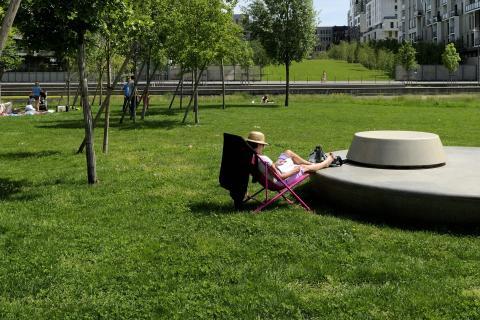
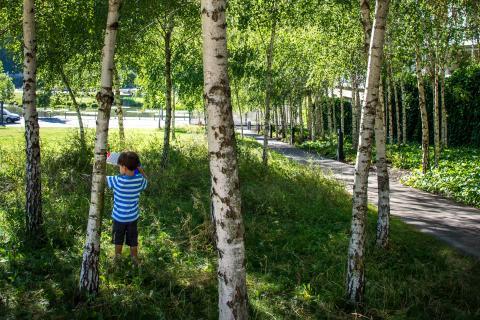
Le Champ will eventually accommodate 1,000 trees spread over 6 hectares, creating a sprawling forest in the city centre. This represents a considerable challenge in terms of landscape development, requiring :
- regeneration of the soil's fertility to accommodate plants and trees,
- varieties and species of local plants and trees that are adapted to an urban environment and climate change,
- a site that is favourable to biodiversity and offering food and habitat to numerous species of insects, the first link in the food chain.
Lyon Confluence has developed an in-situ testing method as part of its transformation initiative. The method is based on :
- a platform for the creation of fertile soil to transform the soil on-site through the use of silt and vegetal waste (compost),
- the use of a hibernaculum to provide shelter for insects and other small animals,
- plant nurseries that will manage the young shoots, starting this fall, intended for Le Champ.

A biodiversity inventory
The biodiversity management practices adopted at the Station Mue park are tested and based on lessons learnt during an inventory conducted last summer. Objective: conduct ecological monitoring of Le Champ to observe the changes and see how the biodiversity develops.
This mission was entrusted to a project management team consisting of a landscape gardener, an engineering firm and specialists in biodiversity and ecology.
«There is an element of innovation in the method used. Our objective is to encourage the development of corporate practices and methods of service management.»
Marie-Paule Coassy, Lyon Confluence Project Manager
The Champ quarter in pictures




Strong values: circular economy, citizen participation and replicability
The developments undertaken in Le Champ fall within a circular economy approach. The project's overriding challenge is to limit the consumption of resources and the transport of materials. The fertile soil platform is an excellent example of this as the importation of agricultural soil is avoided, along with the use of recycled concrete for pedestrian walkways, making it possible to reuse the residues from cement mixers. Tree nurseries are also involved in this approach, providing the young shoots that will be planted throughout the district.
The Station Mue is the critical player in terms of the citizen participation initiative in the Le Champ district. In its current format, this modular and temporary information centre was designed to host events, meetings, and educational and fun workshops. Its goal is to introduce everyone to the Sustainable Development or Nature in the City values being promoted in the newly renovated La Confluence district.
The various experimental approaches developed in Le Champ are intended to serve as examples. These innovative practices, including the creation of fertile soil, recycled concrete and the notion of citizen participation, are designed to implement and evaluate working methods that can be reproduced throughout the entire country. Through these efforts, Le Champ has become a full-scale laboratory, and is a source of inspiration for the 'sustainable city of the future'.
For more information, read the article and watch the video "From industrial soil to fertile soil"
From industrial soil to fertile soil
The Champ, a “field” of creative ideas
The Le Champ district is earmarked for actors of the creative industry sector. Several companies have already begun operations there within the scope of a programme for the adaptive reuse of existing heritage buildings. This is precisely the case with H7, the new incubator for digital start-ups, and Hôtel 71, a creative media and culture hub. New companies will soon join them in two upcoming development programmes :
- The Halle Caoutchouc : a massive building of spectacular dimensions built in 1917, the Hall Caoutchouc will house a research and technological innovation centre focussing on sustainable development.
- Zadigacité : formerly a garage that had been erected during the construction of the wholesale food market. It has been converted into a coworking space for production, research and development around the city's ethics initiatives.
Passing through the Rue Vuillerme
This street, connecting the northern part of Le Champ to the south, can be considered as a structuring space. It has been temporarily refurbished to offer pedestrians more space. The width of the roadway has been reduced in favour of comfortable sidewalks, adapted signage, and of course, vegetation, with the idea of bringing nature back to the concrete jungle.