BIODIVERSITY
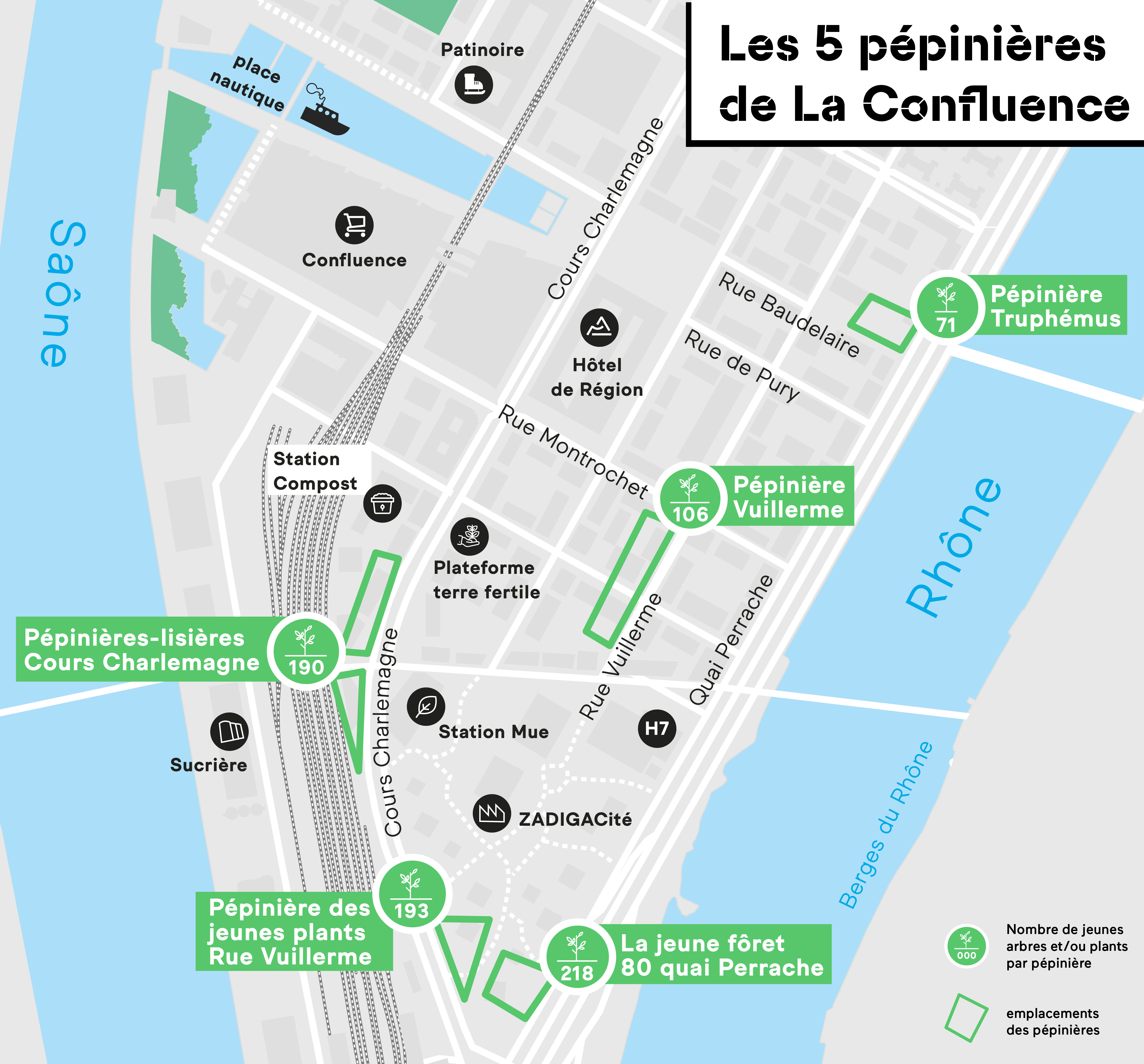
5 nurseries at La Confluence
The fifth nursery at Place Truphémus
A nursery as a temporary urban development
The new nursery is located in the future Place Jacques Truphémus, between Rue Charles-Baudelaine and Allée Jeannne-Baret. Some 71 young trees were potted in mid-February to be planted more easily within a few months. With 24 maples, 16 oaks, 8 prunus, 8 European hackberries, 8 thornless honey locusts and 7 birches, various beautiful shades of green will soon come to decorate the temporarily developed public space.
The truphemus nursery in pictures


Trees for learning
The vast majority of the 71 trees in the Truphémus nursery will be planted on Rue Delandine, which has become a completely pedestrianised garden/square, in front of the future school complex. The students of the new school will take care of the young trees during the winter of 2023/24 after having learned to recognize each species.
Ideal acclimatisation
Natural shapes
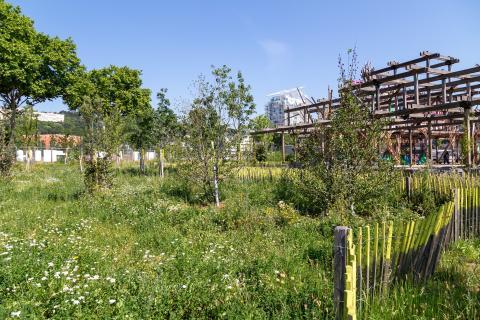
The five nurseries at La Confluence are home to particularly young trees, so that they can successfully acclimatise to their urban environment, their future home. With the young plants less than 30 cm tall and young trees between 8 and 16 cm in circumference, the shoots grow freely at La Confluence, developing natural shapes fashioned by the surrounding area. Planting trees that are already on-site also helps to reduce the carbon footprint!
Circular economy & low energy use: core values at Lyon Confluence
Cultivating trees on site is part of a broader circular economy approach, aimed at reducing the project’s carbon footprint, which is also illustrated by other experiments tested in the Station Mue park:
- Ternatec: a platform for creating fertile soil from silt (site waste), compost and a small amount of topsoil
- Station Compost: a composting site for neighbourhood bio-waste, located near Cours Charlemagne
- Recycled concrete: streets in the Champ area are made of a mix that reuses residue from concrete mixers
Species adapted to today’s and tomorrow’s climates
The range of trees and shrubs is partly made up of local species (ash, hornbeam, maple, etc.), adapted to the current climate. It also includes species of Mediterranean origin (holm oaks, lime trees, etc.), which are more resistant to the high temperatures and droughts of the coming decades. All of this will bring a cool environment and well-being to the people of La Confluence, as well as contribute to the return and development of biodiversity in the heart of the city.
Le Champ, the neighbourhood’s future green belt
Located at the southern tip of the Presqu’île, Le Champ is a vast 6-hectare space destined to become a veritable urban forest. Eventually, 1,000 trees will invite locals to immerse themselves in a peaceful green bubble. The keywords here are “replicability”, “well-being”, “nature”, “biodiversity” and “citizen participation”. It aims to be an oasis for local populations, a showcase for the sustainable city and a unique setting for the creative-industry firms that that set up shop there.